The Foreign Policy Challenges Awaiting Andy Burnham
Our incoming Prime Minister, Andy Burnham, does not want to travel. Fair enough, he’s got plenty on his plate to be cracking on with at home. But, as he’s already pointed out in his recent Times article, what happens at home is inseparable from what happens overseas.
Burnham is taking office at one of the most dangerous times in recent history. Costs of fuel have gone up due to the war in the Middle East; Russian aggression threatens European collective security and Britain directly; climate change every year makes itself known in deadlier and more uneven ways; and rather than getting to grips with new technologies, they appear to be spiralling out of control in ways we cannot foresee. Against this backdrop some of the certainties of the playing field are disappearing; international rule of law and multilateral institutions have lost their credibility and their bite. These are not abstract or intellectual niceties: having rules that countries mutually agree on gives us stability and predictability, two very critical pillars to the economic security plans Burnham will pursue.
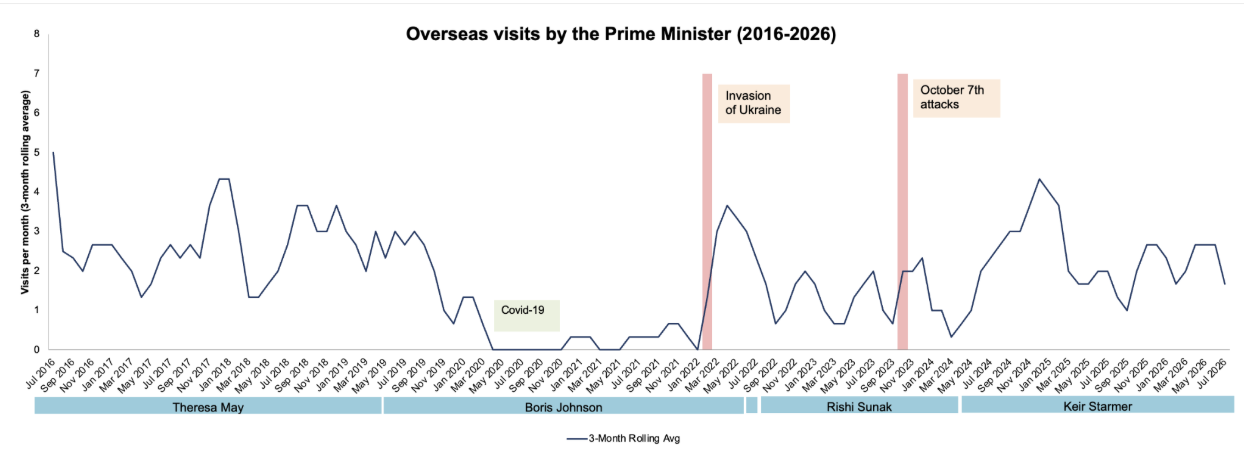
Burnham doesn’t have the luxury of a blank slate or an empty in-tray. But there are benefits to that: Keir Starmer’s government has already made some progress. However, this was not achieved passively. Starmer was criticised as “never here Keir”, going on 60 visits over his time in office. This was almost double his predecessor Rishi Sunak, though in fact signalled a return to normalcy: previous prime ministers including Theresa May and Boris Johnson had similar rates of international travelling (discounting Covid-19-era restrictions). Still, more important than how many is where. Under Starmer there has been a shift away from purely bilateral visits (four to Ukraine alone in Johnson’s last 6 months) to minilateral engagement, especially through the Coalition of the Willing and similar forums like the E3, reinforced through bilateral meetings with the French and Germans.
Even if Burnham sticks to picking a few ‘big moments’ in the year in which to show himself as a ‘statesman’, he risks overlooking the progress that has been made in these smaller gatherings. These are the spaces where crucial work on European security can be advanced, and where the European relationship with the US with regards to security dependency will be fundamentally renegotiated in the next few years, as well as the closer trade cooperation Burnham also seeks. In this regard, one of the biggest first challenges for Burnham will be to successfully enter Britain into the SAFE programme, the EU’s new defence fund which could offer the UK greater supply chain resilience and greater access to industrial procurement. The road to SAFE thus far has been bumpy; careful work and sustained energy will be necessary to move this forward.
Chatham House’s Roli Asthana has described a possible Burnham approach to foreign policy as “International Manchesterism” defined as a “place‑rooted internationalism that treats global forces as inseparable from local outcomes”. No doubt, Burnham’s Times piece reflects this view, but he seems to go a step further, implying that local forces can themselves determine global outcomes. In it he sketches out the beginnings of a re-industrialisation plan, but to carry this plan to fruition Burnham will face a number of challenges.
Firstly, if he wishes us to disentangle ourselves from “foreign dependencies” whilst also encouraging inward investment, it will require confronting security dependency on the US, as well as economic dependency on China. Neither tasks are straightforward or speedy. For instance, the lack of access to critical minerals will prove a serious obstacle for Burnham’s industrial strategy and will require a long-term de-risking strategy. Currently, China refines 73% of the world’s cobalt, 68% of its nickel, and 59% of lithium supplies, which together make up critical elements of the UK’s energy security, used in batteries, EVs and power grids. At the same time, China is also rapidly expanding its control of raw minerals as its influence in mining countries across Africa grows.
Reducing military dependency on the US will also not happen overnight. NATO's Hague Commitment, agreed in June 2025, raises the alliance-wide spending target to 5% of GDP by 2035 - more than double the old 2% benchmark that most members, Britain included, are still working to hit. Under Trump’s administration there have been attempts at leveraging this dependency. In June, Secretary of State, Marco Rubio, spoke critically of European allies that “gave [the US] a hard time” over base access requests, and warned disputes could cast “a real cloud over the NATO alliance”. These and other comments made by American political leaders are unsubtle: help us out with our war in Iran, or we’ll threaten withdrawing support in Europe.
Burnham inherits not just a difficult inbox, but a hollowed-out set of tools for tackling it. The Foreign Office has lost its most senior official, Olly Robbins, leaving his planned restructure, by the Institute for Government's assessment, “directionless and leaving staff unsure what they are prioritising”. That institutional turmoil coincides with a hard fiscal squeeze: aid spending is being cut from 0.5% to 0.3% of GNI by 2027, taking development spend to roughly £9.2 billion, its lowest level since 2012. The BBC World Service, Britain's direct line into contested information spaces, fares little better, its budget rising only marginally over the next three years – nowhere near enough to reverse a decade of retreat. Together, this amounts to a serious sacrifice of soft power at precisely the moment it is needed: it dents the confidence of developing countries that the UK is a reliable long-term partner, and weakens Britain's hand in the multilateral institutions it needs for shared challenges like global health. Burnham, who was Health Secretary during the swine flu outbreak in 2009, knows what can be lost when that capacity is allowed to erode.
Building a more resilient country will require some serious heavy-lifting. Big moments matter, and Burnham should not dismiss them: showing up at UNGA, and steering the UK's G20 presidency with ambition are important. But it is the smaller, less visible commitments – the ones Burnham will be most tempted to skip – that will actually determine whether he delivers on resilience and economic security. That means working consistently with developing countries; it means not letting go of multilateral commitments when they stop making headlines; and, above all, it means the unglamorous, sustained work of navigating difficult conversations with China and the US, and consolidating the gains already made with European allies. None of this happens through occasional attendance. It requires showing up.
Cover image: House of Commons, via Wikimedia Commons, CC BY 3.0