A Centre-Right Foreign Policy for a Fragmented World
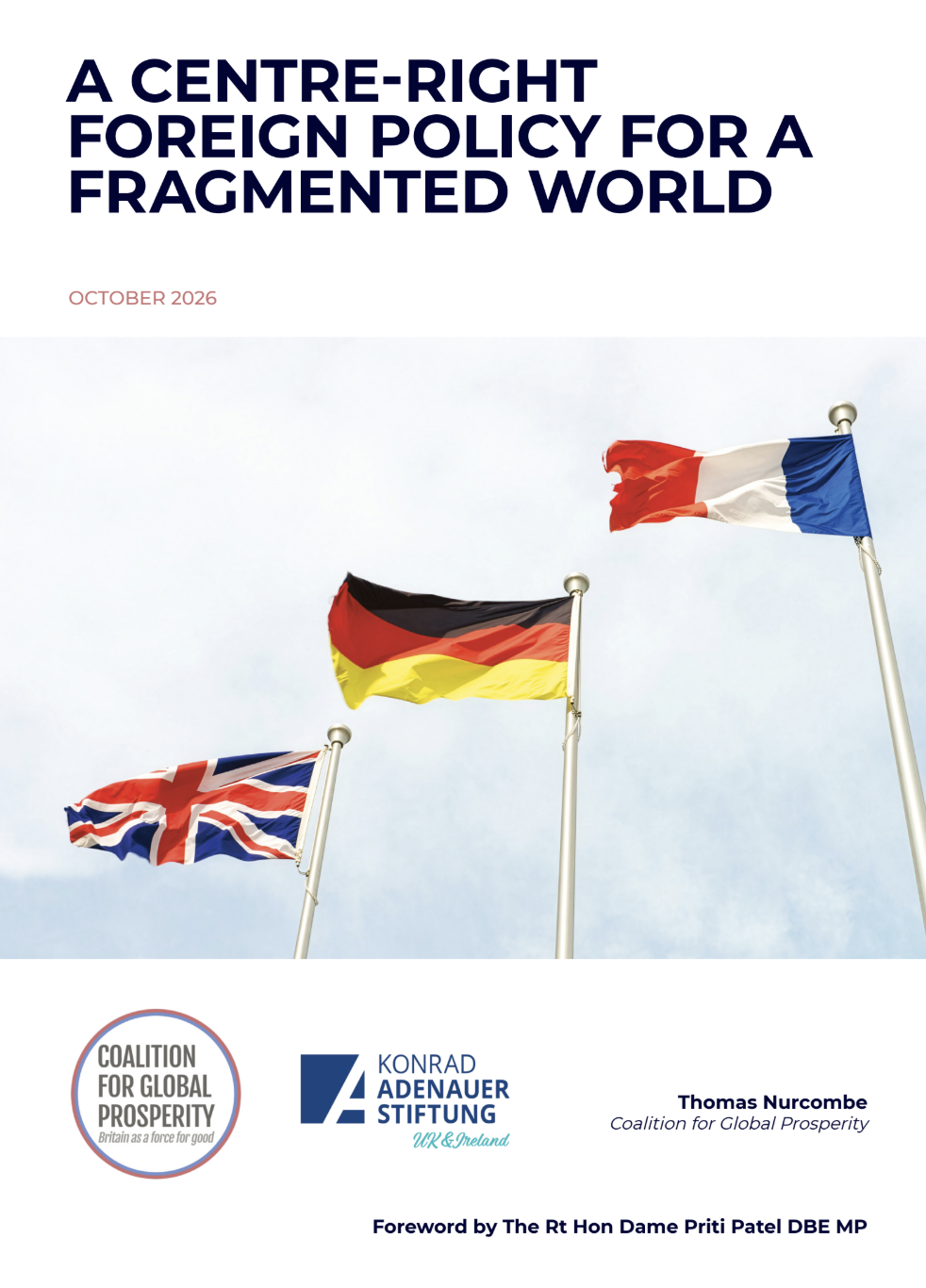
This project between the Coalition for Global Prosperity and the Konrad-Adenauer-Stiftung UK & Ireland seeks to develop a framework for a centre-right foreign policy better suited to a more fragmented and contested world.
For decades, Western foreign policy has been shaped by an assumption that the so-called rules-based international order established after the collapse of the Soviet Union could endure. That assumption was fundamentally challenged by Russia’s annexation of Crimea in 2014 and was shattered by its full-scale invasion of Ukraine in 2022.
Britain and Europe now find themselves between orders, with a struggle underway between a democratic West and a new autocratic axis to determine what comes next. The post-1991 assumptions that have shaped Western foreign policy therefore need to be reconsidered. Rather than passively defending a previous order, centre-right parties must adopt a foreign policy approach that is more assertive and proactive in shaping the international system that emerges.
This report, with a foreword by The Rt Hon Dame Priti Patel DBE MP, sets a framework for a centre-right foreign policy that is tailored for a fragmented world and designed to reinforce efforts to shape an international order rooted in democracy, liberty and rule of law. The framework outlined represents a strategy of constraining and deterring the expansion of autocratic power and influence through the integration of military, economic, technological, diplomatic and soft power instruments, while strengthening the resilience, cohesion and relative power of the West.

“Russia’s aggression against its neighbours and China’s growing assertiveness have demonstrated that strategic competition never disappeared. Instead, our adversaries used the period of Western complacency to strengthen their military, industrial, technological and economic power while the West too often neglected its own capabilities and allowed strategic dependencies to grow.
“The challenge today is therefore not simply to defend the international order that emerged after 1991. We must have the confidence and strength to shape what comes next. That is at the heart of the argument advanced in this report: the centre-right must again make the case for a confident, assertive and proactive foreign policy capable of deterring aggression, protecting our national interests and ensuring that democracy, liberty and the rule of law remain at the heart of the international system.”
- The Rt Hon Dame Priti Patel DBE MP - International Secretary of the Conservative Party; former Home Secretary; former Secretary of State for International Development; former Shadow Foreign Secretary

"Britain cannot navigate this fragmented and increasingly dangerous world with our foreign policy tools pulling in separate directions. For too long, we have failed to bring defence, diplomacy and development together as part of a single strategy. Now, as we enter an era of deep and multidimensional competition, each part of our foreign policy — from hard power to foreign aid — must work towards the same goal: preserving the West’s strategic advantage over Russia and China. Labour is keeping these instruments in silos; the Conservatives will bring them together to make Britain safer, stronger and more influential. This report from the Coalition for Global Prosperity sets out a clear path to do just that.”
- David Reed MP - Shadow Minister for Defence, Security & Resilience

“The world is in an era of strategic competition unlike anything we have seen since the height of the Cold War. What should our response be? National resilience and deterrence must be central to everything we do, from foreign policy and defence to trade and business. Only then will Britain and our allies be in a position to shape the future international system so that it reflects our values and interests. This report from CGP and KAS sets out some ideas to help the West meet the challenge, and come out on top.”
- Bradley Thomas MP - Shadow Business Minister

“Conservatism has proven the reliable foreign policy constant in a more complex world. Open for business, eager for cooperation, adamant in its support for Ukraine and the global order: That is what unites Christian Democrats and Conservatives in Europe and beyond. Valuing the US-dominated world order and the prosperity it brought, while acknowledging the need for constant change to preserve our world both in terms of security and ecology.”
-Jürgen Hardt MdB, Foreign Policy Spokesperson for the CDU/CSU Parliamentary Group in the German Bundestag.

“Europe faces its gravest security challenge since the Cold War. But the threat is no longer a single adversary. It is an increasingly coordinated group of states determined to reshape the international order in their favour.
Europe’s centre-right must respond. That means breaking decisively with the assumptions of the post-Cold War era and pursuing a tougher, more assertive foreign policy designed to constrain Russia and China’s ability to expand their influence and power.
This requires moving beyond frameworks built primarily around normative approaches. Europe must instead significantly strengthen its hard power and deploy its soft power and development tools more strategically. The goal should be a modern form of containment, using every instrument of statecraft to deter adversaries, reduce strategic vulnerabilities and defend Europe’s interests.”
- Thomas Nurcombe, Research Manager at CGP and Author of the report.
Five Pillars for a Centre-Right Foreign Policy
Align foreign policy tools to outcompete the new axis of autocracies: The West risks ceding the advantage to adversaries by pursuing development assistance, soft power and trade objectives independently of defence and security objectives. Britain and Europe should instead integrate all elements of statecraft into one coordinated strategy to strengthen Western power and resilience whilst limiting the ability of autocratic states to leverage military, economic, diplomatic and soft power tools for their own advantage.
Strengthen national and allied power as the foundation of foreign policy: Western nations, particularly in Europe, require a comprehensive strengthening of military, economic, industrial, technological, diplomatic and soft power capabilities to reinforce deterrence and provide the bedrock from which to shape an international system based on Western values.
Prioritise flexible, values-based cooperation: Western institutions such as NATO — and for Germany the EU as well — are foundational pillars, but must be complemented by an increased focus on minilateral and bilateral partnerships across all foreign policy areas that offer a more agile approach better suited to navigating the complexity of the current international system.
Ground Atlanticism in strategic utility: Europe should remain steadfast in advocating for the value of the relationship with the United States. But the objective should be to pursue a truer Atlanticist framework in which European states assume greater responsibility for their own security and play a greater role in wider Western security imperatives. This requires faster increases in defence spending, a fairer distribution of the security burden and a foreign policy recalibrated to compete more effectively with the CRINKs.
Promote open but secure trade: Economic security requires a more selective international economic strategy that prioritises secure trade with allies whilst reducing supply-chain dependencies on adversarial states, particularly China. A coordinated Western approach to friendshoring and de-risking would strengthen allied resilience and prosperity whilst reducing exposure to economic coercion and other geoeconomic vulnerabilities.
Policy Recommendations:
Anchor development assistance within a framework of strategic competition, prioritising the containment of adversary influence and power over the pursuit of global goods.
Synchronise development finance institutions with imperatives of national security, such as by focusing loans and investments on the extraction and processing of critical minerals essential for modern defence industries.
Establish new means of burden-sharing for soft power tools, promoting allied co-funding of established outlets, such as the BBC World Service and DW, to out-compete Sputnik and CGTN.
Continue to push strongly for the confiscation of frozen Russian assets to provide sustained military and economic support for Ukraine.
Consider the inter-governmental development and financing of a sub-strategic nuclear option with key European allies.
Create a pathway from university and degree apprenticeships into armed forces reserves, such as through summer reservist bootcamps.
Fortify societal resilience by expanding media literacy initiatives within educational institutions to help counter hostile disinformation and propaganda, with a strong focus on AI-generated FIMI.
Incentivise more British and German defence companies to expand production in Ukraine, allowing the quicker supply of Ukrainian forces and a more suitable and seamless adaptation to the changing nature of warfare.
Focus on minilateral cooperation for international development efforts alongside NATO and IP4 allies, moving away from a dedication to multilateral approaches to aid.
Strengthen Euro-Atlantic and Indo-Pacific technological cooperation by expanding R&D collaboration with Japan and South Korea in critical domains such as undersea systems, including through greater informal third-party engagement in specific AUKUS Pillar 2 areas.
Encourage the incorporation of Germany into the Global Combat Air Programme (GCAP) following the collapse of the Future Combat Air System (FCAS).
Deepen partnerships with Taiwan to bolster societal resilience and better defend against the spectrum of sub-threshold threats posed by autocratic adversaries.
Promote responsible autonomy, whereby European nations enhance their individual and collective military, industrial and technological power whilst continuing to commit to the US-led alliance and alignment as a Western bloc.
Push forward the timeframe to meet the NATO 3.5% defence spending target.
Set a pathway for Anglo-German leadership in defence of Eastern Europe and the waters of Northern Europe, including through a deepened partnership between the Joint Expeditionary Force and Germany.
Publicly support American-led initiatives to de-risk from China, including Pax Silica.
Prioritise the implementation of friendshoring efforts, specifically targeting critical minerals, pharmaceuticals and semiconductors.
Establish a collaborative mineral stockpiling programme between the UK and Germany, leaving open opportunities for cooperation with like-minded European allies such as Norway and Ukraine.
Implement a concrete ban on Chinese imports for public sector programmes where production is suspected to be linked to slave labour practices.
Ensure that supply chain security is one of the core focus areas in the allocation of Official Development Assistance spending.
The views and recommendations of this report are those of the author and may not necessarily reflect the views of the Konrad-Adenauer-Stiftung or those who supported and provided feedback for the project.