
Lessons From Giorgia Meloni’s Plan For Africa
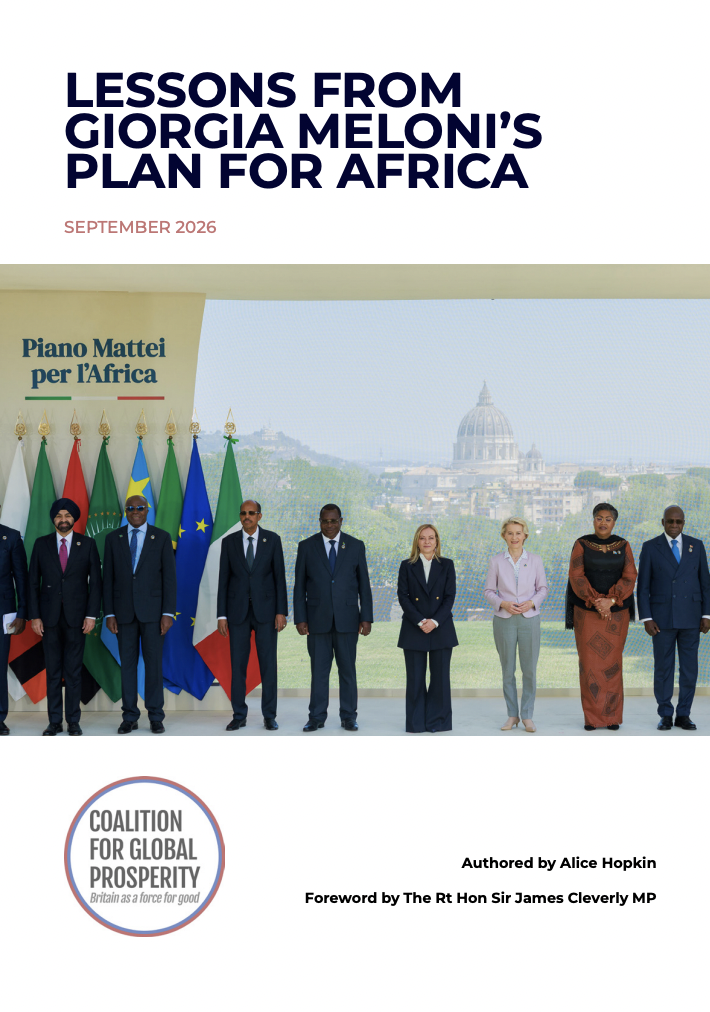
British international development policy has lost public support, and successive governments have responded by cutting the budget rather than addressing the question: what is aid for? In this latest report, Senior Fellow, Alice Hopkin argues that the UK needs to shift away from debate over a percentage or cap and build a redesigned strategy like Giorgia Meloni's Mattei Plan for Africa, centred around a clearly stated national interest and around the assets that can make Britain's partnerships mutually beneficial for our developing allies.

“Having served as Foreign Secretary and Home Secretary, I have seen from both ends of Whitehall how blurred the lines between portfolios can be. The pressures arriving at our borders begin in the places our development and diplomacy are meant to reach. The threats our Armed Forces face abroad are shaped by whether people in fragile states can avoid radicalisation and build a prosperous future at home. Foreign policy, development, defence and border security are one intertwined challenge, not four. The countries that succeed in this century will be the ones that treat them that way.”
- The Rt Hon Sir James Cleverly MP, Member of Parliament for Braintree

“For too long, the debate about international development has focused on how much Britain spends rather than what we are trying to achieve. My report argues that we need to rebuild development policy around a clearer national interest, bringing together trade, investment, migration, security and our relationships across the Commonwealth.
A development strategy supported by the public and defended by Parliament is worth far more to the world’s poorest than one admired by specialists but consented to by almost no one. Giorgia Meloni’s Mattei Plan for Africa shows that it is possible to rethink development from the ground up, make mutual benefit an explicit objective, and build a strategy that people can understand and get behind.”
- Alice Hopkin, Senior Fellow at the Coalition for Global Prosperity
Key Recommendations
Amend the International Development (Official Development Assistance Target) Act 2015 to make it credible. This should be done by retaining 0.7% GNI as an aspiration rather than a binding annual duty; introducing a duty to publish measurable outcomes annually; and developing a strategy which explicitly integrates development with foreign, defence and security objectives.
Adopt a pillars framework and reduce scope inside the UK International Development brand. UK development should be reorganised around a small number of clearly defined strategic pillars, for example trade and investment; health and pandemic security; women & girls; energy and critical minerals; infrastructure; and education to stop the sprawling portfolio.
Improve UK International Development’s visibility with a better communications strategy, beginning with a single, accessible public-facing platform under the UK International Development brand.
Launch flagship Advanced Development Partnerships with priority partner countries. The point is not to start from scratch, but to organise and present what Britain already does as a coherent, strategy that can be grown where necessary. This will show reciprocal partnership rather than a scatter of unconnected programmes.
Put trade at the centre alongside energy and investment, scaling our already successful systems. Advanced Development Partnerships should be paired with concrete trade measures, like expanded use of the Developing Countries Trading Scheme, support for the African Continental Free Trade Area, duty-free access for value-added African goods, and the mobilisation of UK project-finance expertise.
Reignite the UK-Africa relationship at the highest level by hosting another UK-Africa Investment Summit co-designed with the African Union, and treat the Commonwealth Heads of Government Meeting as a strategic priority. It is not just the ‘D’ in FCDO that is being neglected, but also the ‘C’.
Partner and scale with like-minded allies. At a time of shrinking Western budgets and an assertive China, the UK should look to build on successful work done by like-minded countries, particularly those sharing the impacts of migrations flows across the European continent.
Separate Advanced Development Partnerships from those where partnership is not possible. A credible strategy must be honest about the states where mutually beneficial development partnerships are impossible.
Establish a Cabinet sub-committee on migration source and complex states.
Fund the first safe country: Where migrants originate in conflict states, the most humane and cost-effective intervention is to support the neighbouring countries that host the overwhelming majority of the displaced.
Deliver targeted emergency humanitarian and stabilisation engagement in active conflicts such as Sudan, which should be ring-fenced and distinct from the partnership agenda.
About the author
Alice Hopkin is a Senior Fellow at the Coalition for Global Prosperity, with a background in government, policymaking and legislation.
She previously served as a Special Adviser in the UK Government to the Home Secretary (2023–24), Foreign Secretary (2022–23) and Health Secretary (2021–22). Across these roles, she advised on international development, migration and border security, global health, international crisis response during major global conflicts, and a range of wider foreign policy issues.
Alice is a Pershing Square Scholar at the University of Oxford, where she is completing the Oxford 1+1 MBA and Master of Public Policy.