
Discussion Paper
The 1951 Refugee Convention
and a Crisis of Credibility
In the aftermath of the Second World War, Europe was confronted with a crisis of staggering proportions: 55 million people had been forcibly displaced across the continent. It was recognised that an international legal framework would be necessary to ensure that those who had lost the protection of their own state could find it elsewhere. The result was the 1951 Convention Relating to the Status of Refugees — a landmark achievement that set the rules for how the world manages large numbers of forcibly displaced people, and which continues to form the basis of that system today.
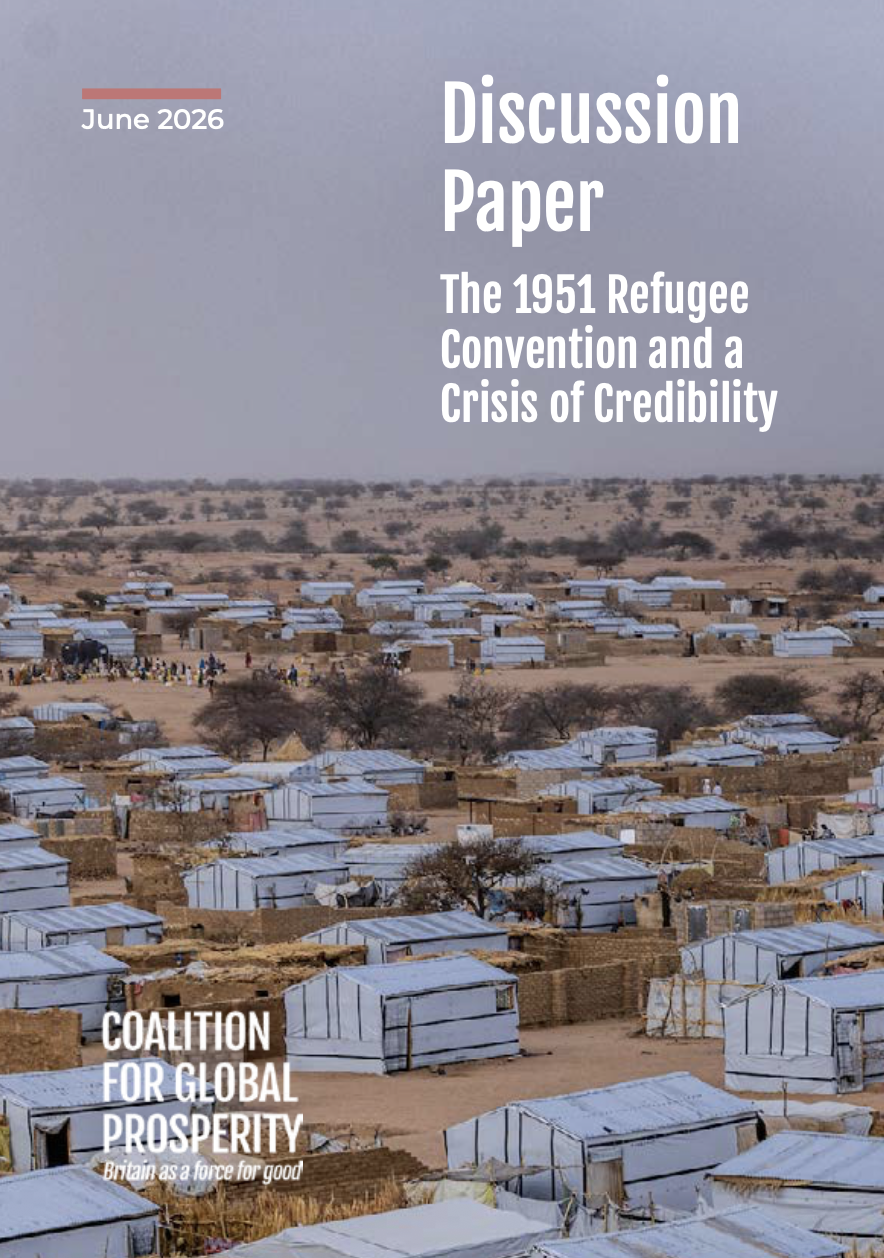
Yet over time, cracks in that initial design have begun to show. The international context has changed beyond all recognition. Refugee numbers are far greater now, driven by protracted conflicts, in greater numbers. The return of great power competition and retreat from multilateralism has undermined the forums through which transnational challenges like refugee flows can be addressed. Our current system has also produced large numbers of people trapped in camps for decades — "forever refugees" with no prospect of return, resettlement, or any other durable solution.
The result is a system under serious strain: inconsistently applied, chronically underfunded, and haemorrhaging the domestic political legitimacy on which any international treaty ultimately depends. This paper traces the origins of the Convention, examines how it has intersected with the refugee crises of the 21st century, and asks a harder question than whether the Convention's principles remain valid — it asks why the system built on those principles commands so little political legitimacy, and what it might take to restore it.
The paper identifies five overlapping challenges confronting the Convention:
An outdated definition of who counts as a refugee: Those fleeing conflict have been allowed to claim asylum, despite not being specifically targeted under Article 1’s definition. Others claim that displacement caused by climate change challenges the constraints of Article 1. Though not anticipated by the drafters at the time, climate change has created enormous pressure on the current refugee protection system, and may ultimately create an entirely new category of refugee altogether. Though current trends indicate that those displaced by climate shocks tend to be internally displaced rather than refugees, this may change in the future, and will undoubtedly require further international attention in the coming decades.
The Convention was made for a specific time and a specific place: Shaped by Cold War dynamics, some argue the Convention remains too Eurocentric to be fully applicable to today’s refugee crises which by-and-large are located outside of Europe. The definition in Article 1 reflects the mentality of the time, and many states, especially in South East Asia, point to this Eurocentricity as a reason for non-accession.
The absence of a structured burden-sharing mechanism: While some of the Convention's general "silences" have allowed for flexible, ad-hoc regional agreements, ultimately it fails to mandate collective burden-sharing. Because there are no rules governing which states receive refugees and in what numbers, the international system has to come up with new ideas every time, often falling short of what is required.
No clear definition of a “safe” country? The Convention remains silent on the criteria needed to define a "safe" intermediary country. An enduring, unresolved debate around Article 31 therefore remains regarding whether refugees transiting through multiple countries are "coming directly" from a threat or are "country shopping" for better conditions. This is critical to the Convention’s political legitimacy.
The inability to deal with “forever refugees” The architecture was originally built to handle the short-term, temporary transit of Europeans following WWII. Today, this outdated approach has contributed to a system of "forever" refugees who are trapped in camps for decades without autonomy or sustainable solutions, presenting a large burden on host states.
What next?
These failures are not isolated; they are mutually reinforcing, and they have eroded the political legitimacy on which any international treaty actually depends. A Convention that cannot provide sustainable solutions to refugee protection in a manner which can sustain contact with today’s political realities will eventually no longer be taken seriously. However, the window of opportunity to make the necessary updates is closing quickly; the collapse of the system will follow a familiar pattern: very slowly, then all at once. The credibility of the international refugee protection system is at a historic low, and without an update, what is currently a slow-burning erosion of legitimacy will fall into a crisis of credibility.
The questions raised by this paper have too rarely been asked with the rigour and political realism they demand. The Coalition for Global Prosperity's new programme of work seeks to address this, led by the Rt Hon Alex Chalk KC, former Lord Chancellor and Justice Secretary. Over the coming months, we will examine the case for reform of the 1951 Convention and its surrounding architecture, drawing on the legal, historical, and political analysis set out above, and on the regional and supplementary instruments that have already begun to fill its gaps. This will not be a narrowly legal exercise: as this paper has argued, the deficiencies in today's refugee protection regime are as much about political legitimacy and domestic consent as they are about treaty text. That means remaining anchored in political and geopolitical reality, including the recognition that formally re-opening the Convention text may create more problems than it solves, requiring us to cast the net wide on solutions. We seek to answer a single question: to meet this moment what should the international architecture for refugee management look like in the twenty-first century?